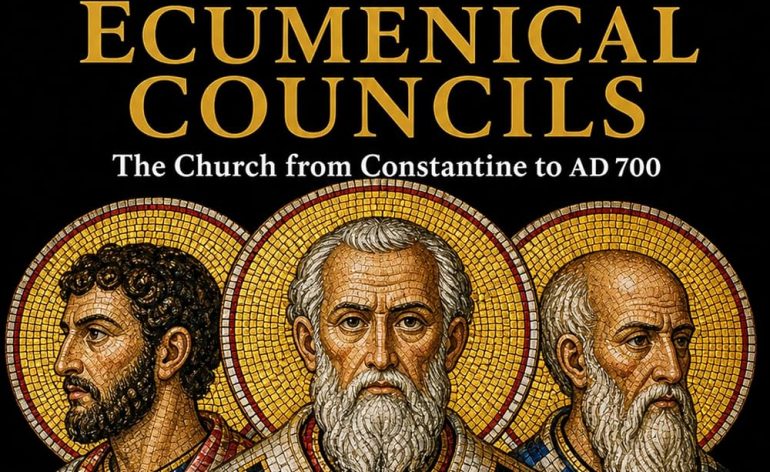
History of the Orthodox Church: The Ecumenical Councils, the Church from Constantine to AD 700

Price: null - $29.99
(as of Oct 10, 2026 06:59:07 UTC – Details)
How did the Church defend the faith confessed in the Nicene Creed?
Behind the words Christians pray stands a history of fierce controversy, courageous bishops, imperial pressure, exile, and extraordinary theological conviction. From the conversion of Constantine to the close of the seventh century, the ancient Church struggled to express with precision what it believed about the Holy Trinity and the person of Jesus Christ.
History of the Orthodox Church: The Ecumenical Councils brings that world into view through the work of Philaret Vafeidis, a Greek Orthodox churchman, teacher, and historian. Drawn from his 1884 Ecclesiastical History, this English reader’s edition follows the Church from Constantine to AD 700, placing the great councils within the wider life of early Christianity.
Follow the first six Ecumenical Councils and the struggles surrounding them:
Nicaea I, 325: Arius, the divinity of the Son, and the confession that shaped the Nicene faith.Constantinople I, 381: the continuing struggle over Arianism and the confession of the Holy Spirit.Ephesus, 431: Nestorius, the title Theotokos, and the unity of Christ’s person.Chalcedon, 451: the confession of Christ as truly divine and truly human.Constantinople II, 553: the continuing Christological controversies and the divisions that followed Chalcedon.Constantinople III, 680–681: the controversy over Christ’s wills and the Orthodox confession of His divine and human willing.
These were questions that reached far beyond the council chamber. They shaped relations between churches, influenced imperial policy, divided communities, and sent bishops into exile. Vafeidis follows the people and events behind the doctrinal language, helping readers see why the disputes mattered and why their consequences endured.
Discover the wider world of the Church Fathers.
The narrative also explores the decline of paganism, the reign of Julian the Apostate, the spread of Christianity in East and West, and the rise of Islam. It examines the growth of monastic life, the clergy and patriarchates, the primacy of Rome, and the relationship between Church and state. Chapters on worship trace the Church’s feasts, holy mysteries, veneration of saints, relics and icons, preaching, hymnody, and sacred art.
A substantial final section turns to theological literature: Greek, Syriac, and Latin Fathers, Christian teachers, hymnographers, and poets. Along the way, encounter Athanasius, Basil the Great, Gregory the Theologian, Cyril of Alexandria, and Maximus the Confessor in their historical setting. The result is a connected account of early Church history in which doctrine, worship, spiritual life, and the Christian Roman Empire belong to the same unfolding story.
For Orthodox Christians seeking the historical roots of their faith, readers exploring Eastern Orthodoxy, and students of patristics, Christian theology, or Byzantine history, this volume offers an explicitly Orthodox perspective on the age of the councils. Vafeidis writes with the convictions of a nineteenth-century church historian; his judgments and emphases remain part of the character of the work.
The history ends at AD 700 and covers the first six Ecumenical Councils. The Seventh Council, Nicaea II in 787, falls outside this volume.
Read the history behind the Creed, and encounter the Church that preserved and proclaimed it.
ASIN : B0HHYM63D5
Accessibility : Learn more
Publication date : September 6, 2026
Language : English
File size : 3.6 MB
Screen Reader : Supported
Enhanced typesetting : Enabled
X-Ray : Not Enabled
Word Wise : Enabled
Print length : 235 pages
Page Flip : Enabled
Best Sellers Rank: #1,103,840 in Kindle Store (See Top 100 in Kindle Store) #407 in Ecclesiology Christian Theology (Kindle Store) #541 in Christian Orthodoxy (Kindle Store) #980 in Christian History
#History #Orthodox #Church #Ecumenical #Councils #Church #Constantine